I recently upgraded my collection of books by W.G. Sebald by acquiring two rather hard to find copies of his 1990 book Schwindel. Gefühle (Vertigo). The first volume is one of the limited edition of 999 specially bound copies. These were done in a pale green leather and accompanied by an even paler green cardboard slipcase. This edition was issued simultaneously by Eichborn Verlag with the trade edition which had an initial print run of 10,000 copies. Internally, the only difference is the final page of the limited edition, which is hand numbered in ink but not signed by Sebald.

I also acquired a fine copy of the trade edition that includes the Cellophanschuber, or cellophane slipcover. My first copy of this book didn’t have one and now I understand why: it is an extremely fragile, almost transparent thing that probably got tossed or torn most of the time. The cellophanschuber boldly proclaims the enclosed book to be a first edition (erstausgabe). More intriguing, however, it also provides Sebald’s first work of prose fiction with a brief description or blurb that does not seem to have been used anywhere else:

Vom leisen Inferno der Depression und von der Unheimlichkeit des Glücks.

In my humble and no doubt amateur translation, this reads something like “From the quiet inferno of depression and the eeriness of fate…” (Anyone want to take a better shot at this?)

It appears to me that German booksellers use various terms for this kind of transparent paper slipcase, including Pergaminschuber and Rückenschild.  [The Rückenschild, I am told, is the pasted label on the spine.  Thanks, Claus.]

Last year I wrote about the various first editions of Schwindel. Gefühle and Vertigo here.

Valuing The Rings of Saturn

February 12, 2008

grant-wood-february.jpg
Grant Wood, February, 1941 (lithograph)

I should have posted this a few days ago but somehow got distracted. Must have something to do with the fact that we’ve received more than forty inches of snow this winter and our old snow blower is getting a real workout.

Bookride is a fascinating blog about book selling, book collecting, and rare book prices operated by the folks who run the bookstore called Any Amount of Books on Charing Cross Road, deep in the heart of London. It describes itself as a guide to the most wanted and collected books. There is some evaluation of why the book is wanted, what it is worth - with a range of selling prices, some trivia, apercus and bon mots, a few anecdotes, so called jokes and occasional rants.

On February 7, to topic was the British first edition of W.G. Sebald’s The Rings of Saturn. If you take a look, also scroll down to see the long list of other book collecting links.

emigrants-auerbach-2.jpg

When W.G. Sebald’s Ausgewanderten (1991) was translated and published as The Emigrants in England, the new 1996 version came with a renamed fourth chapter and two fewer photographs. The chapter that was originally called Max Aurach in the German edition became Max Ferber in English. As Maya Jaggi recounts in Recovered Memories, an interview-based article in The Guardian September 22, 2001, one of the two sources for the character Max Aurach was the English painter Frank Auerbach, who apparently did not want to be so closely identified with the book now that it was coming out in English. And so the character’s last name was changed from Aurach to Ferber and Auerbach’s painting, which had appeared on page 240 of the German book, was removed. Jaggi writes:

He [Sebald] is conscious of the danger of usurping others’ existences. While all four emigrants are based on real people, the painter Max Ferber, who obsessively scratches out then redoes his work, is a composite of Sebald’s Mancunian landlord (”I found out he’d skiied in the same places as I had”) and the London-based artist Frank Auerbach. Without naming Auerbach, Sebald says he felt he had the right - “because the information on his manner of work is from a published source”. Auerbach, however, refused to allow his paintings to appear in the English edition. Sebald modified the character’s name from Max Aurach in the German. “I withdraw if I get any sense of the person’s discomfort,” he says.

The second photograph that was removed is a close-up of a man’s face, and, given its placement in the text where the narrator of The Emigrants recognizes a painting by “Ferber”an exhibition catalog from the Tate Gallery, it seems safe to say the face probably belongs to one of the two sources for Ferber - either Auerbach or Sebald’s landlord from his Manchester days.

I studied Ferber’s dark eye, looking sideways out of a photograph that accompanied the text, and tried, at least with hindsight, to understand what inhibitions or wariness there had been on his part that had kept our conversations away from his origins… (page 178 of the American edition)

emigrants-eyes-2.jpg

In creating Max Aurach/Ferber, Sebald also transplanted Auerbach from his adopted London to Manchester. In the book, Ferber says:

Manchester has taken possession of me for good. I cannot leave. I do not want to leave. I must not. Even the visits I have to make to London once or twice a year oppress and upset me. (page 169)

Not only did Sebald relocate Auerbach to Manchester, he transfered his allegiance to London onto Manchester. Earlier this year the Economist.com (February 3, 2007), reported on Auerbach’s dislike for leaving London:

“I HATE leaving my studio. I hate leaving Camden Town. I hate leaving London.” So speaks Frank Auerbach, a German-born artist who came to London from Berlin as a boy on the eve of the second world war, and whose parents died in the Holocaust. Mr Auerbach reckons he hasn’t spent more than four weeks away from his adopted home since he was seven.

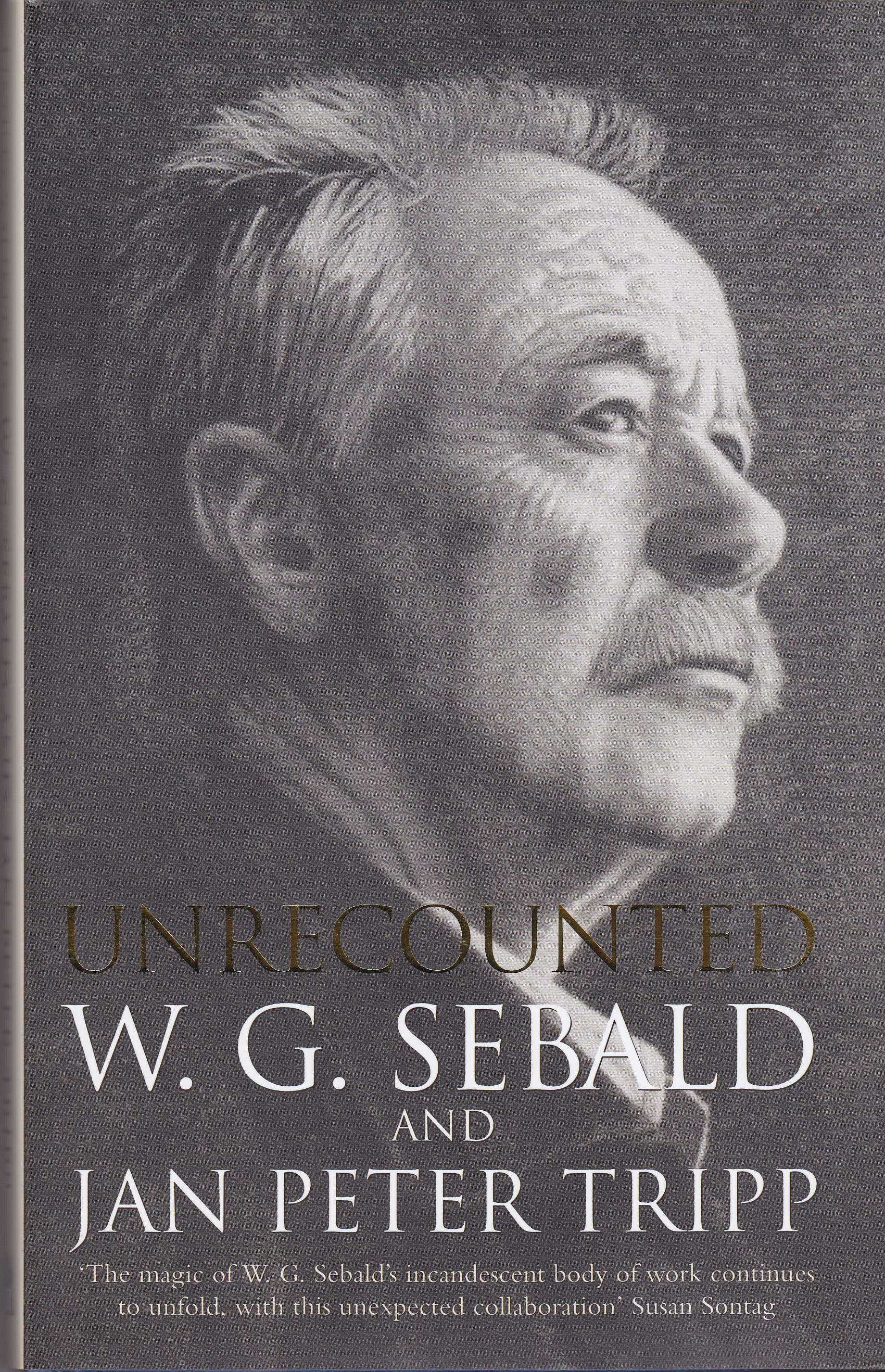
By the way, the photograph of Aurach’s eye which goes missing in English-language editions, foreshadows by more than decade Sebald’s book of poems Unerzählt (Unrecounted), in which each poem is accompanied by an illustration showing only the eyes of a person. It also set the stage for the cover photograph used for the British edition of Vertigo (Harvill, 1999).
eyes-javier-marias.jpg [The eyes of Javier Marias, from Unrecounted] sebald-british-vertigo.jpg

In spite of his growing international acclaim, the German and true first edition of W.G. Sebald’s Austerlitz appears to have been released in a small first run before going into multiple printings.It is my impression that it is easier to find first printings of the German trade editions of Schwindel. Gefuhle (released in 1990 in a first printing of 10,000 copies), Die Ausgewanderten (published in 1992 in a run of 7,000), or Die Ringe des Saturn (released in 1995 in a first run of 10,000 copies). As soon as Austerlitz came out (Munich: Hanser Verlag, 2001) I bought a copy signed by Sebald from a German dealer and when it arrived I was surprised to find that it was already a second printing.Hanser identifies the printing states on the copyright page using the simple code that many American and British publishers use. The code on the first print run would read 1 2 3 4 5, with the smallest number being dropped for every subsequent printing.The Hanser edition is bound in a green (almost gray) cloth with a silver-stamped red leather sticker on the spine and the book comes with a red cloth page marker.

The mysterious cover photograph has almost taken on a life of its own. The photograph of a young fair-haired Aryan boy in an all-white costume and holding a white tri-cornered hat was used on the first editions of Germany, Britain, and the United States shows. It’s an image that seems to me less connected to the character Austerlitz himself and more to Germany’s pre-World War II nostalgia for a glorious past.(Could that actually be the young Sebald or is it just one of his flea market photograph finds?)

The first trade edition in Great Britain (London: Hamish Hamilton, 2001) was bound in maroon cloth with a gold-stamped spine.My copy is signed by Sebald on the title page.I have seen one dealer claim that there are different states to the dust jacket, with the earliest state having the price on the rear flap rather than the front flap, but I cannot confirm this.

The British trade edition was preceded by two versions of the “Uncorrected Proof Copy.”One version served the usual purposes of providing advance reading and review copies.The proof is a compact, expense-saving octavo eight inches high and 357 pages long, in comparison with the more substantial trade version that Hamish Hamilton put out, which measures nine inches high and is 416 pages long and 50% thicker. A version of the “Uncorrected Proof Copy” was turned into a limited edition that is now one of the more expensive items for a Sebald collector. There were 100 numbered copies of this special edition, each signed by Sebald.I don’t own one of the limited editions, so I cannot provide a comparison with the ordinary “Uncorrected Proof Copy.”

Random House put out the American edition of Austerlitz in the fall of 2001, bound in sepia brown paper boards with a silver-stamped black paper spine.Unlike the German and British editions, which each run around 415 pages, the larger page format of the American edition allows the book to check in at 298 pages.One of the small, easy to overlook treasures of the Random House first edition is the back cover blurb by poet W.S. Merwin (which was apparently too poetic to be retained when the book went into paperback). Merwin writes:

With untraceable swiftness and assurance, W.G. Sebald’s writing conjures from the details and sequences of daily life, and their circumstances and encounters, from apparent chance and its unsounded calculus, the dimension of dream and a sense of the depth of time that makes his books, one by one, indispensable. He evokes at once the minutiae and the vastness of individual existence, the inconsolable sorrow of history and the scintillating beauty of the moment and its ground of memory. Each book seems to be something that was purely impossible, and each (upon every re-reading) is unique and astonishing.

Now that’s blurb writing.

Random House issued a paperback “Advance Reader’s Edition” that looks practically identical with the first edition.

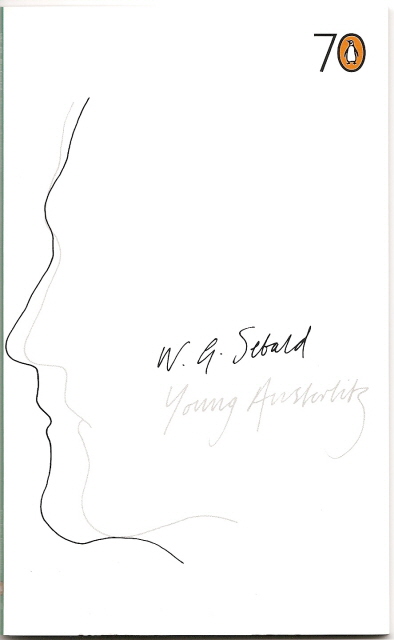
In 2005, as part of the celebrations of its 70th anniversary, Penguin (which owns Sebald’s British imprint Hamish Hamilton) issued excerpts from 70 titles spanning its publishing history.Austerlitz was chosen to represent the year 2001 and so a 58-page excerpt from Austerlitz was published in a slim paperback under the title Young Austerlitz.The excerpt covers pages 44 to 96 in the American edition, in which Austerlitz describes part of his childhood in Wales.

Finally, a bookmark from Hanser promoting the German edition of Austerlitz.

Campo Santo is a hybrid volume, a posthumous act of packaging by W.G. Sebald’s German publisher Hanser. When Sebald died December 14, 2001, very shortly after the appearance of his fourth work of prose, Austerlitz, he apparently had not begun a new prose project. So, in 2003, Hanser dipped into his past and assembled Campo Santo, a gathering of eighteen previously published short pieces that represent both of Sebald’s distinct types of writing – his prose and his essays.

corsica-satellite-photo.jpg Satellite view of Corsica

The crucial part of this book is the first section, which contains the four prose four pieces. After finishing The Rings of Saturn in the mid 1990s, Sebald, we are told, began a book on Corsica, which he eventually set aside in favor of Austerlitz. Three of the four prose pieces on Corsica were published during Sebald’s lifetime, albeit in separate German language sources between 1996 and 2001. The piece selected as the title piece for this new volume, Campo Santo, did not appear until 2003 in the German magazine Akzente: Zeitschrift fur Literatur. According to the editor of Campo Santo Sven Meyer, the Corsican fragments form the only new prose pieces by Sebald we are likely to see. Quoting his Editorial Note from the English-language editions: “Sebald’s literary estate, which has not yet been studied and edited, contains no other recent literary works.” (It does make one wonder how that conclusion was reached if the estate had not been, in fact, sorted through.) At any rate, the main achievement of Campo Santo is to bring together the Corsican fragments for the first time.

corsica-map.jpg Corsica, circa 1635

To round out the contents of Campo Santo, Hanser added fourteen previously published essays, mostly on literary subjects, including several on Sebald’s perennial favorite – Kafka. In the English-language editions of Campo Santo, by the way, the essays on Peter Weiss and Jean Améry are omitted. They had been already been translated in the process of repackaging and adding material to Sebald’s 1999 book Luftkrieg und Literatur when it appeared in English as On the Natural History of Destruction in 2003.

The Corsican prose pieces in Campo Santo pose interesting questions for the reader of Sebald. The most obvious issue to me concerns the lack of images in the three main pieces. All four of Sebald’s full-length prose works employ images as an essential part of the “text.” But, with one exception that I’ll mention momentarily, the Corsican pieces are devoid of images. Was this going to be an unillustrated work or would Sebald have added images before finishing the manuscript? I vote for the latter. (I confess that I have not seen the original German publications in which A Little Excursion to Ajaccio, Campo Santo, and The Alps in the Sea first appeared as distinct writings, but I am assuming they were not accompanied by illustrations.)

As I mentioned, there is one exception. One of the four prose pieces includes a single image. It occurs in a fragment called La Cour de l’ancienne école (The Courtyard of the Old School) that is less than two pages long and only tangentially deals with Corsica. The image reproduced is a pen and colored ink drawing by artist Quint Buchholz depicting a wall and a gate and an indeterminate view beyond. As it turns out, this was not an image selected by Sebald, it was an image sent to Sebald in hopes his response could be included in anthology of writers’ responses to Buchholz’s images. In the prose fragment, Sebald explains that the image was sent to him “with a friendly request for me to think of something appropriate to say about it.” Sebald writes that he agonized over his response until this picture of an unknown subject suddenly disappeared one day, permitting him to abandon his assignment. Eventually, however, one of his regular correspondents mailed the picture back to him asking why he had sent her a picture of her childhood schoolyard in one of his recent letters. The school yard, coincidentally, turned out to be in Corsica. Sebald’s response, in the form of this small fragment with its French title, was published in Buchholz’s BuchBilderBuch (Zurich: Sanssouci, 1997).

campo-santo-german.jpgcampo-santo-british.jpg

The German edition of Campo Santo (Munich: Hanser, 2003) is a compact octavo bound in gray boards with a simple silver-stamped black sticker on the spine. On the front of the slightly textured, matte dust jacket is a superb portrait of Sebald, looking as serious as ever and holding his eyeglasses in his hand.

The British edition (London: Hamish Hamilton, 2005 is bound in navy blue cloth with a gold-stamped spine. Its cover design is based on a dramatic 1932 photograph by André Kertesz. The title is embossed across the front of the just jacket in gold lettering with a faint black outline, giving the volume a very elegant touch.

campo-santo-american.jpgcampo-santo-proof.jpg

When Campo Santo came out later that year in the U.S. (New York: Random House, 2005) the first edition was bound in gray paper-covered boards with silver-stamped black paper spine. Random House chose a different direction in their dust jacket design, opting for a misty landscape image (presumably Corsica) by the Magnum photographer Raymond Depardon. In some ways, I think the American cover with its image of a path winding down a hillside is truer to Sebald’s Corsican texts, but it strikes me as less dramatic and arresting than the British cover.Random House also issued an unknown number of “Advance uncorrected proofs” in their standard decorative blue wrappers that simply repeat the Random House logo.